Documentation burden
Clinicians spend valuable time turning complex encounters into structured notes — time that could be spent on patient care, clinical thinking, and meaningful interaction.
QIQA helps clinicians and healthcare teams turn conversations, calls, and clinical encounters into structured, reviewable documentation — with human oversight, auditability, and privacy-aware design at the centre.
Designed for clinical review, research evaluation, and deployment in healthcare settings.
Clinicians spend valuable time turning complex encounters into structured notes — time that could be spent on patient care, clinical thinking, and meaningful interaction.
Transfer calls, ward handovers, and post-operative documentation often lose critical context in translation between teams, departments, and care settings.
AI-generated notes must be rigorously checked for omissions, hallucinations, and clinically material errors before any clinical use. Responsible deployment requires this by design.
Healthcare conversations often involve code-switching, regional accents, and language variation — particularly in African settings — that generic AI tools are not designed to handle.
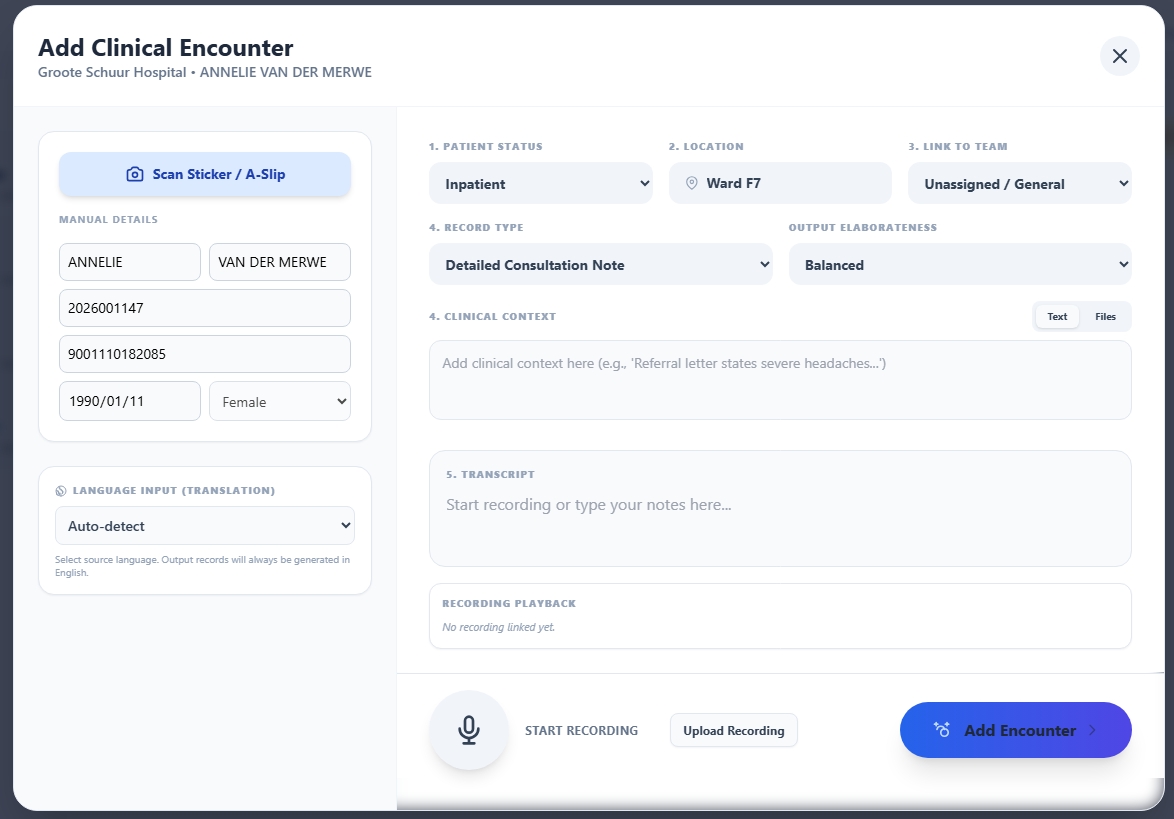
Convert recorded or live clinical conversations into structured SOAP notes that clinicians can review, edit, and approve before any clinical use.
DocumentationGenerate structured medico-legal post-operative notes including diagnosis, procedure details, operative times, closure, and supporting codes where supported by the transcript.
SurgicalCapture referral and transfer calls into structured transfer forms with patient details, clinical reason, urgency level, and clear handover information for receiving teams.
TransferSupport doctors and hospital departments with structured extraction of key clinical details, decisions, and action items from consultation and handover transcripts.
DepartmentsCompare AI-generated outputs against expert assessments, score note quality, and identify clinically material discrepancies to support responsible evaluation and governance.
EvaluationSupport review processes with saved transcripts, generated notes, quality checks, and fully traceable outputs designed for institutional governance requirements.
GovernanceAudio is recorded or streamed from a clinical encounter, ward round, or transfer discussion — securely and with appropriate consent management.
Speech is converted into a transcript, preserving the source conversation for traceability. The original transcript remains available for all downstream review.
AI assists in converting the transcript into clinical documentation, forms, summaries, or evaluation outputs — never as a final product, always as a draft for review.
Clinicians or authorised reviewers check, edit, approve, and use the final output. Clinical responsibility remains with the reviewing clinician at every stage.
QIQA keeps the human in the loop. AI assists with structure and drafting, while clinical responsibility remains with the clinician or authorised reviewer at every stage.
For GPs, specialists, and clinics, documentation time is a constant pressure. QIQA is designed to support faster, structured SOAP notes, referral letters, and patient summaries — without removing the clinician's editorial control over the final record.
Hospital and department workflows require governance, audit trails, and structured communication across teams. QIQA supports ward rounds, clinics, handovers, referrals, post-operative notes, and quality review workflows with institutional oversight in mind.
QIQA is built with evidence generation as a core feature, not an afterthought. Research teams can use the platform to benchmark AI-generated notes, score quality, compare models, and build clinically meaningful evaluation datasets.
Healthcare conversations in South Africa and across the African continent often involve multiple languages, code-switching, and regional healthcare terminology. These realities create important challenges for clinical AI tools. QIQA is currently being developed and evaluated in a South African clinical setting, with future work planned to explore how the system can better support multilingual and code-switched healthcare conversations.
Every AI-generated output is a draft. Clinical responsibility always rests with the reviewing clinician.
Every generated note is traceable to its source transcript, supporting full auditability of AI-assisted documentation.
Review actions, edits, and approval decisions are captured and stored for institutional oversight and quality assurance.
Designed with POPIA-aware workflows in mind, supporting data minimisation, access controls, and secure clinical data handling.
Granular access control ensures that clinical data and review workflows are accessible only to authorised users.
Built-in tooling to identify and score clinically material errors in AI-generated outputs as part of responsible development practice.
Developed to support future regulatory and institutional review processes, including structured pilot evaluation frameworks.
QIQA is being developed as a clinical support and documentation platform. It is intended to assist authorised healthcare users and does not replace professional judgement, clinical responsibility, or institutional governance.
QIQA has been evaluated in a real-world clinical setting, comparing AI-generated ambient clinical notes with contemporaneous handwritten notes. This research provides an important evidence base for understanding how QIQA performs in practice: what it captures accurately, where human review remains important, and how ambient documentation can be assessed safely in clinical care.
The study reflects a core principle behind QIQA: clinical AI should not only be built and deployed, but measured. By grounding development in prospective evaluation, QIQA is being shaped around evidence, safety, and the realities of everyday healthcare documentation.
A prospective real-world evaluation at Groote Schuur Hospital comparing QIQA-generated ambient clinical documentation with contemporaneous handwritten clinical notes across clinical encounters. The study examines the accuracy, safety, and clinical reliability of AI-generated notes, providing early evidence for responsible use of ambient scribing in healthcare.
Read the preprintThe study evaluated QIQA in a clinical setting, comparing AI-generated ambient notes with contemporaneous handwritten clinical notes.
Clinical experts assessed the quality, accuracy, and completeness of AI-generated documentation against the source consultation.
The evaluation considered omissions, hallucinations, and clinically meaningful discrepancies to understand where human review remains essential.
Interested in contributing to the evidence base for clinical AI in healthcare?
Partner with us on evaluationQIQA is preparing for future pilots, demonstrations, research collaborations, and healthcare workflow evaluations. Register your interest and tell us how you would like to explore the platform.
The QIQA team will be in touch regarding pilots, demonstrations, and research opportunities. This form is ready for future CRM, email, or database integration.